

Any infrastructure or future planning in a technology realm should be based and focused on future generation’s survival matrix.
Kerala has a land area of less than 2% of India but accommodates 5% of the population. This is a serious issue when it comes to state level planning from villages to metro level.
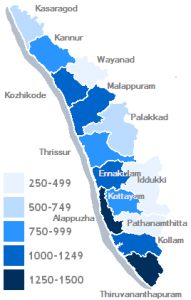
Based on the above, we know that our land banks are very limited, which hampers a horizontal spread any more. The only viable alternative left to us is planning in a vertical axis.
Meaning, it is high time to switch over to a vertical planning sequence. And it implies that in future, planning agencies should focus on 70 to 75 % verticality and about 20 to 25 % horizontality to accommodate infrastructure which are ground or zero level specific.
K-Rail - A brief description
In 2017 an agreement was signed between Government of Kerala and Ministry of Railways to form a Joint Venture Company to compliment Indian Railways in building Railway infrastructure in the State of Kerala. The company was named Kerala Rail Development Corporation Limited (K-Rail). K-Rail undertakes project development works for an identified set of projects, including surveys, preparation of Detailed Project Report (DPR) and getting requisite approval, processing for sanctioning of projects and implementing the same.
The SilverLine project
The SilverLine project undertaken by K-rail is a 530.6 km semi high-speed rail line connecting Thiruvananthapuram and Kasargode through 11 stations with an estimated cost of Rs. 63,941 crores.

My Opinion
Based on the ground reality let me write what I feel about the K-Rail project.
- Apart from any other criteria the K-Rail is going to be a stand alone entity from a National perspective. The country needs Rail grids like power grids to come to our rescue whenever it is required on a pan India basis. The cost projection of K-Rail is astronomical and therefore the ROI (Return Of Investment) Scenerio is very bleak, may be 25 to 30 years instead of the projected 16 years by the Paris based Systra consultancy group on mobility solutions .
- A start up requirement for any project undertaking is a DPR(Detailed Project Report). Before initiating the DPR the following viz social, environmental, geological, ecological and biodiversity impact studies have to be undertaken. As far as my knowledge goes none of the componenets mentioned above is supported in the DPR uploaded by K-rail, except for the Geological impact survey . Based on the DPR, they are supposed to get approvals from the Railway ministry, Environmental agencies and finally the Central Government. The union Railway minister Shri Ashwini Vaishnaw, has already told the CM of Kerala a little while ago that financial support will not be extended. That implies, no approvals will be accorded by any central agencies and therefore by Government of India even.
On 15th of January, the K-Rail DPR comprising 3773 pages (6 Volumes) was released by Kerala Government. It contains Environmental Impact Assessment (EIA) study, feasibility study, traffic survey, geotechnical investigation report, and a study on the impact on lives.
Though the report claims that these studies were undertaken, in reality it has not been done the way it should have been. A DPR should have some basic impact profiling. In this case those are Environmental, Ecological, Geological, Sociological and Biodiversity impacts. And as the DPR uploaded by K-Rail a few days ago is not at all supported by any or the above components, except Geological Impact Survey, it generously qualifies for a ubiquitous AK-47 assault for sure!
- Majority of the enablers or equipments are coming in from foreign shores(Mainly Japan) to facilitate international borrowings. And that happens to be the only criteria to go for a Standard Gauge, which is not familiar to the Indian conditions. This is totally against the “Make in India” policy which is a valid threat concept for possible reverses in future
- The ticket fare is out of reach for the common man and it will be available only to 10% of the population (3.6 million out of 36 million)
- It is a threat to the Biodiversity perspective of our land and vulnerable when it comes to environmental, flooding and seismic interferences.
- As it is a stand-alone entity it is totally out of the Indian rail grid.
Then the RORO(Roll in and Roll out) freight services cannot be integrated into the system as it is a Standard Gauge. And a hopelessly consumarized Kerala is heavily dependent on interstate freight movement to bring in products and services from industrial, commercial and agricultural hubs of India. - Indian railways have already initiated hydrogen traction to major-in on the Green Energy mode by retrofitting the existing locomotives and they may not be willing to retrofit the locos of the Standard Gauge. In such a situation K-Rail has to bring in foreign mechanics to do so. It is going to be a vicious circle indeed.
- The population threatened with uncertainty is unjustifiable compared to the unknown benefits of the venture.
Therefore, we can conclude with reasonable certainty that the current K-Rail project is a totally unwanted undertaking and a no-go project as far as Kerala is concerned at this point in time.

Points to consider
Length of the silver line - 530 km.
Tracks - Standard tracks 1.43 meters wide.
Estimated cost 65000 crores.
In reality it could be around 1.1 lakh crores.
Construction time frame proposed -5 years. But it will take 10 years.
Alternative Solutions
Let us look at what the best fit for us in this situation.
We need a fast track facility to get us in to the future. And it has to be cost effective, environment friendly, geologically and sociologically compatible etc. This takes us to the only choice of making use of the existing rail route map and by exploring all possible planning options before arriving at the best solution .

A 3-tier Plan
In my opinion a 3 tier planning for the present and future mobility of Kerala needs to be considered, as follows:
- Straighten out the existing Broad Gauge line between Trivandrum and Kasaragod by retrofitting the bends and curves and simultaneously strengthening the rest of the tracks wherever required so as to enable the conventional track to achieve 200 km speed. This can be achieved in a couple of years and spending 10% of the K-Rail cost. Once that is settled super fast trains now serving Central and Northern railways like Gatimaan(India’s first semi-high speed train that runs between Delhi and Virangna Lakshmibai), VandeBharat, Janshadabdi etc. at 160Km/per hour can be pressed into service in Kerala. If possible even the tracks can be re-laid as concrete slab tracks instead of the present ballast tracks. (This is the case with regards to high speed tracks in Japan and China). Considering an average speed for these trains due to stop overs at 130 Km/ hour we can cover the 570 KM broad Gauge length in 4.5 hours as designed for the silver line. And remember such a facility is very much in place within 2 years instead of the actual 7 to 10 years of silver line and can be done in approximately 8000~9000 crores. implying savings of around 80,000 crore. This in turn will reduce the ticketing cost considerably so that approximately 30 million people can afford to use it while achieving the same speed and time of the K-Rail .
This proposition can circumvent all issues about which a vast majority is making a hue and cry now . - Once the above is completed, work on a Dual Carriage Line next and parallel to the existing one by making use of all infrastructural facilities available in the existing systems like stations etc. to negotiate the next 50 years or so of the projected mobility requirements of Kerala while retaining the “Make in India” policy.
- The 3rd phase should be to go over pillars as an alternative planning route in the vertical axis, using current amenities, which can fulfill the designed projected planning period of a 100 years. Beyond this point we have already the provision of another line on pillars over the parallel dual line and so on and so forth.
Eventually for all of this we need the Central Government back-up and support to circumvent or apply a “Vacuum or Air brake” on the Southern Railway ( Tamil Nadu for that matter) lobby trying to plant bottle necks on the aspirations, progress and requirements of the people of Kerala.
I welcome suggestions and opinions from my readers on this topic…
While expressing my views on the subject, there are no political or lobby inclinations in whatever I write and the same is only undertaken by aligning with the aspirations, desires and expectations of the fellow human beings around us.